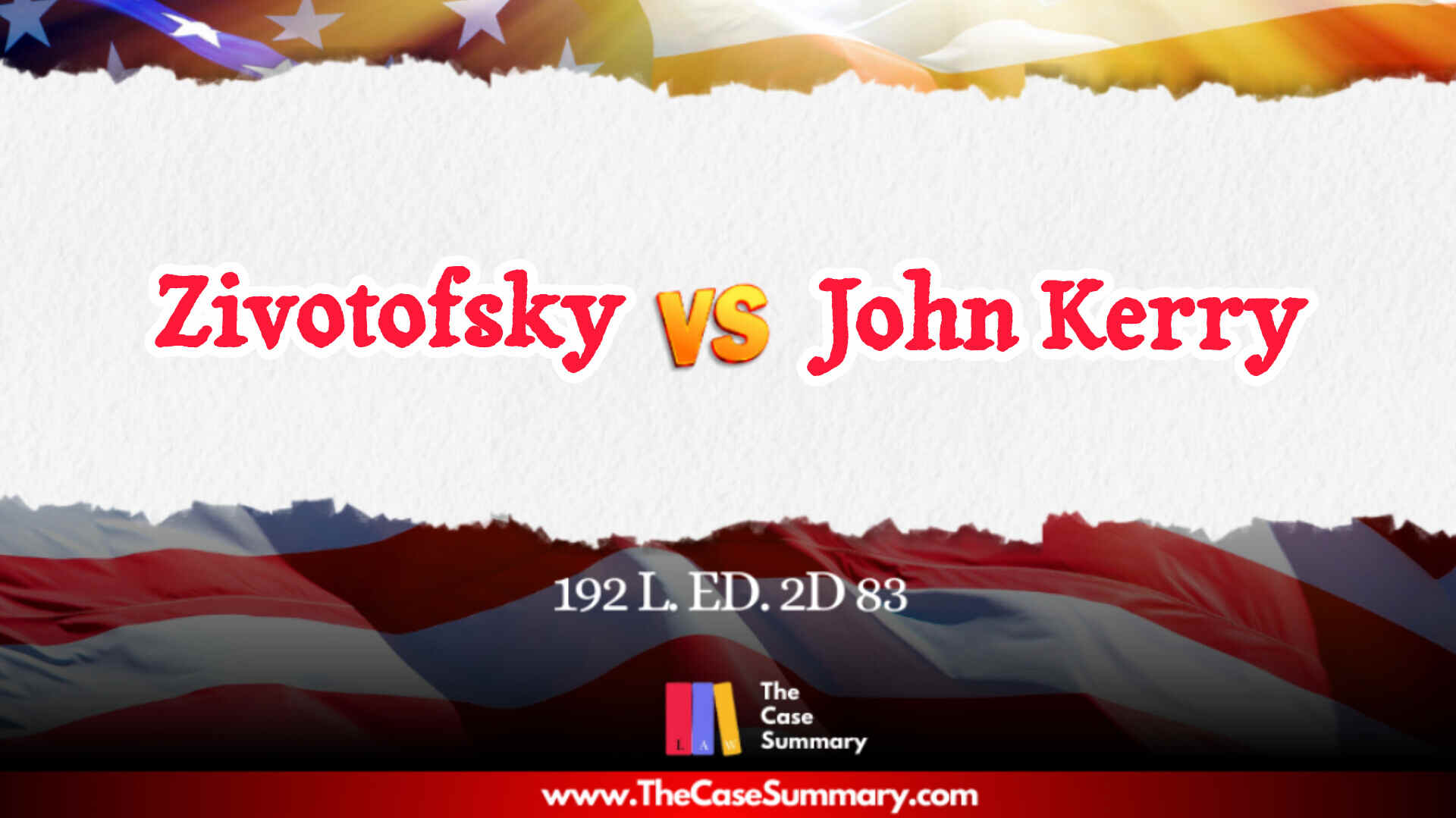
Menachem Binyamin Zivotofsky vs John Kerry, Secretary of State
Citation: 5192 L. Ed. 2d 83
Jurisdiction : United States of America
Petitioner: Menachem Binyamin Zivotofsky [By His Parents and Guardians, Ari Z. and Naomi Siegman Zivotofsky]
Respondents: John Kerry, Secretary of State
Facts :
The case litigation is centered on a United States citizen, Menachem Zivotofsky, who was born in 2002, just a few weeks after the adoption of Section 214(d) of the Foreign Relations Authorization Act. In the past, the U.S. Presidents, since the formation of the State of Israel in 1948 have adopted a policy of neutrality as far as Jerusalem was concerned warning that a single recognition of Jerusalem as an annexed part of Israel would destabilize the entire Middle Eastern balance and undermine the position of the United States as an unbiased mediator in the Middle East peace processes. This executive position was, however, overtaken by a succession of legislative actions by Congress that eventually resulted in Section 214(d) which explicitly states that passports must include Israel as the place of birth to the citizens born in Jerusalem. The parents of Zivotofsky responded by suing, arguing that the President has a duty to follow laws that have been passed by Congress and cannot claim an executive immunity on the account of a matter that concerns foreign affairs. The Executive however refused to complies outright claiming that doing so would constitute interference with presidential prerogatives in state recognition and might indeed jeopardize U.S. diplomatic interests.
Issues :
1. Whether Congress and the President can articulate conflicting foreign policies, or must the Executive have final say to maintain unity?
2. Whether the Reception Clause (Art. II, § 3) and the Executive Power Clause confer exclusive authority to the President, even though the Constitution does not explicitly mention recognition?
3. Whether the President retains authority that Congress cannot override when acting contrary to a statute (the “Lowest Ebb” of power), testing the balance between congressional power and presidential authority in foreign policy?
Arguments :
Petitioner’s Arguments (Zivotofsky & Congress):
Congress argued that it holds plenary power over naturalization (Art. I, § 8) and can decide how citizenship documentation is presented. They emphasized that a passport is primarily a domestic administrative document, and listing “Israel” merely reflects a geographic fact, not a diplomatic statement. They warned that allowing the President to ignore Section 214(d) under the guise of foreign affairs could enable executive overreach, undermining congressional authority and the rule of law. Claimed Section 214(d) created a “statutory right” for citizens to identify their birthplace as they see fit, similar to how citizens born in Taiwan may list “Taiwan” instead of “China.”
Respondent’s Arguments (Executive/State Department):
The executive argued that the Reception Clause and the Executive Power Clause gave the President the sole power to recognize foreign states; and that even such minor clerical modifications of passports could be internationally interpreted as an indication of a change in U. S. foreign policy with potentially dire consequences, such as violence or interception of peacekeeping operations. They insisted that diplomacy requires unity, speed, and dispatch, something that can only be assured by the Executive, but by its very nature, the Congress is deliberative. These arguments highlight the fact that the prerogatives of the President in the foreign affairs should not be tampered with by statutory requirements set under the Constitution.
Decisions :
The Supreme Court, in a 6–3 ruling, sided with the President. The majority Court ruled that the President has exclusive constitutional power to recognize foreign states, derived from the Reception Clause and Executive Power Clause, creating a “sole organ” authority. Section 214(d) was unconstitutional because it compelled the Executive to contradict its recognition policy. The Court emphasized that while Congress can regulate passports procedurally (fees, fraud prevention), it cannot use them to send diplomatic signals. This decision reinforced that recognition of foreign sovereigns is exclusively presidential, and even statutory claims or personal rights cannot override the President’s constitutional prerogatives.
Chief Justice Roberts warned the ruling of the majority will create an unhealthy precedent, allowing the President to override statutes which are not explicitly sanctioned by the Constitution. Justice Scalia argued that recognition is a formal legal tool, and a passport is simply an administrative document and that the President was exaggerating the secondary consequences. The dissent highlighted the issues of executive overreach at the cost of congressional supervision, but the majority argued that the U.S. foreign policy unity and consistency were to be maintained at all costs and costs in order to protect national interests.
Relevant Legal Principle :
Doctrine of Political Questions: The Doctrine of Political Questions recognizes that some issues are more appropriately resolved by the political branches, either the executive or the legislature, rather than by the courts. Under this principle, the judiciary refrains from intervening in matters that require political discretion, policy judgment, or lack clear legal standards. It reflects the understanding that certain questions are so politically sensitive that they lie beyond the proper role of an apolitical judiciary.
Doctrine of Lowest Ebb: Doctrine of Lowest Ebb means that the President’s power is at its weakest when he acts contrary to the express will of Congress, and in such situations, executive authority is strictly limited and subject to close judicial scrutiny.
Relevant Laws :
- The Constitution of the United States
- The Foreign Relations Authorization Act (2002) (USA)
- Section: 214(d)
Author :
1. Saraf Al Sakif
Note : The Case Summary is a platform by the law students, for the law students. We aim to summarize the facts and decisions of various important cases in both Bangla and English with utmost caution. However, this platform is in no way a replacement for going through the complete judgements by the law students and we discourage any learner from relying on case summaries alone. Thank you